
What if anatomy teachers have an easy-to-use game authoring tool to create interactive lessons to teach human anatomy?
On a brisk autumn morning, Maya walks across the bridge to the Anatomy building of the Grenoble University Hospital. As a first-year student in the French Medical curriculum, she is one of around 1800 students that take Anatomy lessons. Others in her course include students from Dentistry, Pharmacology and Physiotherapy. The initial classes are all online and are more general to benefit a diverse audience. Following these online lessons, they have specialised in-person teaching sessions in the amphitheatre for smaller groups of about 100 students each. Students send questions and a list of topics they need help understanding in the online courses to the professors 3 to 4 days before the amphitheatre sessions. Professors incorporate these questions into their lessons and discuss other problem topics. At the end of the year, the students sit for exams in their chosen fields. Around 1/10 of the students from the first year pass the exams to join the medical track in the second year. Maya hopes to be one of them.
As the class on the knee joint starts, Maya follows along with the professor’s illustrated slides. Previously, professors would draw the anatomical part on the chalkboard as they taught – to visualise the anatomical structure, part by part. Still, with the increasing number of students and time constraints, professors now use labelled illustrated slides instead of hand drawing in every class.
After the class, she picks up her worksheets and heads to the quad with her friends, where they immediately, and rightfully, start complaining about the workload and complexity of understanding and retaining anatomical knowledge. It is a subject they have to master very quickly and remember for the rest of their medical careers. It is hard to visualise all the anatomical parts and their connections in the healthy state, leave alone their pathologies. Maya wonders how to improve this. In her Public Health class, they discussed using serious games to teach hygiene and microbiology to children. The games were engaging, and the learning objectives blended into the gameplay, which made learning new things feel like part of the quest. Could this approach of scientific storytelling be applied to anatomy teaching? What if her teachers could design a game, tailormade to her courses?
Gamifying anatomy motivated the design of our authoring system, where teachers create text-based games for their anatomy lectures. It is the extension of our video authoring system that takes scripts and generates animated video lessons. In this case, our software takes game scripts written in text and creates an interactive lesson. Teachers can reuse the slides, illustrations and animated videos they made for their classes in the game. It combines exploration with evaluation so students like Maya can keep track of the learning objectives they have achieved. In our scenario, Maya could access the game after her online classes. She would play through the lesson, identify the most difficult parts, and formulate questions for the amphitheatre session. She can also share the results with her professors directly, giving them an overview of her progress.
An example of the playthrough:
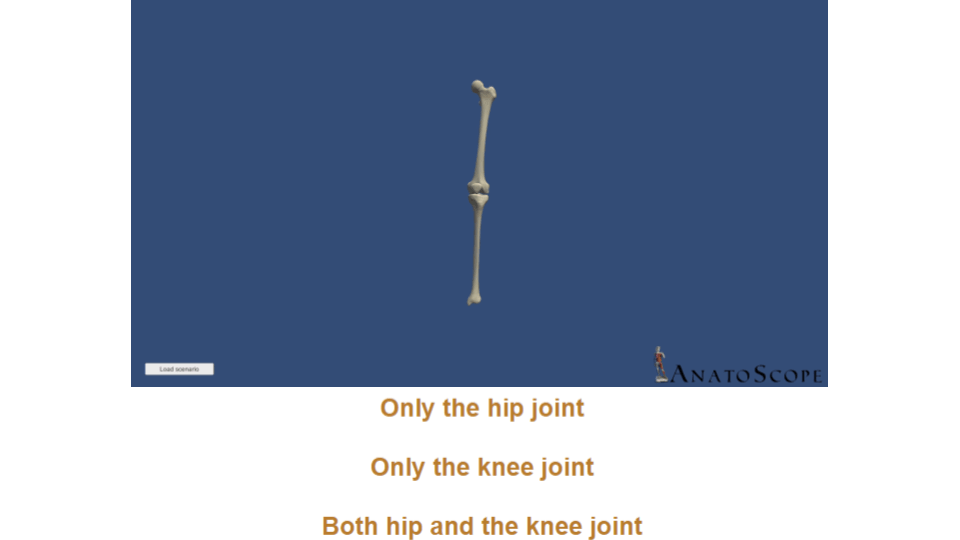


This way, anatomy teachers can turn the entire curriculum into an interactive game. Our game authoring system allows a building block approach for developing the game, so each component is made and edited independently. The Applications and Extension chapter of my thesis gives a detailed analysis of interactive storytelling in education and the tools used. Please feel free to contact me for further discussion.
 Vaishnavi Ameya Murukutla